Mattress Materials
Latex Mattresses Explained: Dunlop, Talalay, and What the Differences Mean
Latex has a distinctive reputation: buoyant, responsive, and made in a range of constructions from natural rubber to blended formulations. But the words Dunlop and Talalay describe processing methods, not a simple ranking of quality. Understanding what each method can mean for density and feel—and how layers, firmness, and materials work together—makes it easier to compare mattresses without getting lost in the terminology.
Published October 22, 2026
What “latex” means in a mattress
Latex used in mattresses is an elastic material made from rubber. It may be produced from natural rubber tree latex, synthetic rubber, or a blend. The word on a product label can therefore refer to more than one thing: the source of the rubber, the method used to turn it into foam, or the place it occupies in the mattress. These details matter, but none tells the whole story on its own.
In a latex mattress, the material may form one or several substantial support and comfort layers. A finished design can combine latex with other components, such as cotton fabric, wool batting, or a coil support unit. Even an all-latex mattress can feel quite different from another all-latex model if its layers have different firmnesses, thicknesses, or arrangements.
Latex is often described as springy or buoyant. Rather than slowly settling around the body in the way some people associate with memory foam, it tends to respond promptly when pressure shifts. That quality may feel lively and easy to move across, though personal impressions vary. A mattress’s cover, quilting, foundation, and overall construction all influence the experience too.
For shoppers, the useful question is not simply, “Is this Dunlop or Talalay?” It is: What is the mattress made of, how is it layered, how firm does the complete design feel, and does that combination suit the sleeper?
Dunlop latex: the established route
Dunlop is a long-established process for producing latex foam. In broad terms, liquid latex is placed into a mold, heated to set, then washed and dried. The result is a resilient foam structure that is commonly described as relatively dense and substantial. That is a general tendency, not a promise that every Dunlop layer will feel the same.
Manufacturers can create Dunlop layers in different firmness levels and thicknesses. A firm layer near the bottom of a mattress may contribute foundational support, while a softer upper layer can provide more initial cushioning. The character of the finished bed depends on the entire stack—not only on the process used to make one component.
Some people appreciate the grounded, stable impression they associate with Dunlop. Others may experience a particular Dunlop mattress as too firm, too yielding, or simply different from what they expected. Density, firmness, and perceived comfort are related but distinct ideas. A dense layer is not automatically a firm one, and a mattress label does not substitute for clear information about the actual comfort options.
When comparing a Dunlop design, look for details such as the firmness offered for each layer, the total mattress height, whether layers can be rearranged or replaced, and whether the manufacturer identifies the latex as natural, blended, or synthetic. If the product description gives only a process name, ask for more specific construction information.
Talalay latex: a different foaming process
Talalay latex is produced through a process that adds further steps to foaming. The mold is not filled completely; air is introduced to expand the latex before it is frozen and then cured. The process can create a foam with a more uniform cell structure. Talalay is often associated with a lighter, more consistent feel, but those descriptions are broad impressions rather than guarantees of comfort.
Talalay latex is commonly used in comfort layers, where a softer or more buoyant sensation may be desired. It can also appear in mattresses that combine different latex types or firmnesses. A mattress containing Talalay does not necessarily feel soft: the firmness of the layer, its thickness, what lies beneath it, and the cover can all change how it performs.
As with Dunlop, Talalay is a processing label, not a complete statement about the latex’s origin or environmental attributes. A shopper interested in material sourcing should check whether the product specifies natural rubber, synthetic latex, or a blend, and should review any certification claims individually. The name of a process alone does not establish that a mattress is organic, chemical-free, or made to a particular standard.
The contrast often presented—Dunlop as dense and firm, Talalay as light and soft—can be a useful starting point, but it is too neat to stand as a buying rule. A soft Dunlop layer and a firm Talalay layer are both possible. The actual specifications and the complete mattress design deserve more attention than shorthand descriptions.
Dunlop vs. Talalay: the meaningful differences
Both methods produce resilient latex foam, and both can be used in thoughtfully designed mattresses. Their differences are most helpful when considered as part of a wider comparison rather than as a contest with one universal winner.
| What to compare | Dunlop | Talalay |
|---|---|---|
| Processing | Latex is molded, heated to set, then washed and dried. | The process includes expansion and freezing before curing. |
| Common impression | Often described as substantial or dense. | Often described as lighter or more uniform. |
| Possible mattress role | May appear in support or comfort layers, depending on firmness and design. | May appear in comfort or support layers, depending on firmness and design. |
| What the label cannot tell you | Exact firmness, suitability, latex source, or how the full mattress will feel. | Exact firmness, suitability, latex source, or how the full mattress will feel. |
Both types can provide a responsive surface, but the sensation is shaped by the complete construction. One layer’s behavior is moderated by the layers above and below it. The same foam may feel different when it is used as a thin comfort layer rather than as a deep component in a layered mattress. Quilting and fabric can soften the first impression; the base and bed frame may also influence stability.
Nor does the processing method alone determine durability. Latex quality, formulation, layer thickness, use, care, and the mattress’s supporting foundation all play a part. Be cautious of sweeping claims that one method is always longer-lasting, healthier, or more comfortable. Look for specific construction details and transparent warranty terms instead.
The construction questions that matter most
1. What is the latex made from?
Ask whether the latex is natural, synthetic, or blended. These terms refer to composition, not the Dunlop or Talalay process. If a product description uses phrases such as “natural latex,” check whether it explains what that means for the particular layers. If certifications are mentioned, verify which component is covered and what standard the certification addresses.
2. How many layers are there?
A mattress may contain one latex core or several separate layers. Multiple layers can allow manufacturers to combine different comfort and support characteristics. In a customizable design, layers may be rearranged or exchanged, which can offer flexibility—but only if the retailer explains how the configuration works and what exchange terms apply.
3. How thick is each layer?
Layer thickness affects how the body interacts with the materials beneath it. A thin soft layer over firm latex may create a different surface feel from a thicker soft layer over the same core. Compare the measurements of individual layers when available, not just total mattress height.
4. What does “firmness” refer to?
Firmness labels such as soft, medium, and firm are not universal scales. One maker’s medium may not match another maker’s. Ask how firmness is described, whether the scale is specific to the brand, and whether the mattress can be tried or adjusted. If you are shopping remotely, review return, trial, and exchange policies carefully, including any fees or eligibility limits.
5. What is the cover made of?
The cover is part of the sleep surface, not merely decoration. Quilting, fabric, and any batting between the cover and latex can change how quickly the mattress responds and how plush it feels at first contact. Wool, cotton, and synthetic textiles each have different properties and care requirements. Check whether the cover is removable, and whether it can be washed or should only be spot-cleaned.
Matching latex design to sleep preferences
There is no processing method that suits every sleeper. A useful comparison starts with the kind of comfort you prefer and the support you need from the bed as a whole. Consider your usual sleep position, the pressure you feel at shoulders or hips, how readily you want the surface to respond when you move, and whether you share the mattress with someone who has different preferences.
Side sleepers often pay close attention to cushioning around the shoulders and hips, while back and stomach sleepers may be more sensitive to whether the surface feels too yielding through the middle of the body. These are starting points, not clinical rules. Body shape, mattress firmness, pillow height, and individual comfort all matter. A mattress cannot diagnose or treat pain, and persistent discomfort is best discussed with a qualified health professional.
Couples can look for adjustable or split configurations where available. Some layered mattresses allow different firmness choices on each side, particularly in larger sizes. That can be more useful than choosing Dunlop or Talalay based on a single shared preference. Confirm precisely which sizes support separate configurations and whether the layers can be changed later.
People who are sensitive to heat should assess the full sleep system rather than relying on a material label. Latex construction, cover fabric, bedroom temperature, sheets, mattress protector, and bed base can all affect the experience. Breathability claims should be weighed against the actual layer arrangement and the textiles surrounding the foam.
A practical example of customizable latex
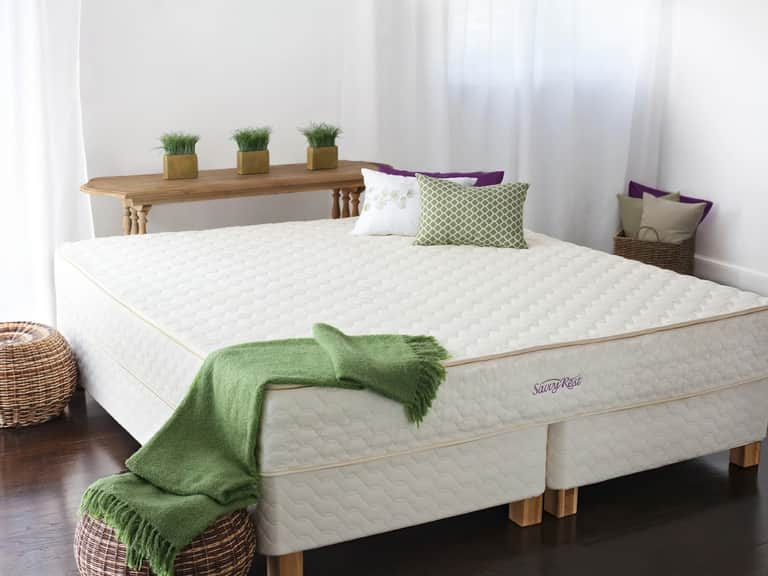
The Savvy Rest Serenity Latex Mattress illustrates why a mattress’s layer plan can be as important as its processing labels. It is a 10-inch design with three customizable latex layers, offered in soft, medium, or firm options. The listed configuration uses Dunlop layers, while the product information also describes Talalay as an available choice. Its organic cotton casing is quilted with wool, and Queen and King sizes can be configured differently on each side.
This example is useful as a construction reference, not as a universal recommendation. It demonstrates how a mattress can combine layer choice, a quilted cover, and side-specific options. Anyone evaluating a similar design should confirm the exact latex type in each layer, the firmness arrangement, the exchange policy, and the care instructions before deciding. In this case, the cover is removable but requires spot cleaning rather than machine washing, and the manufacturer describes a limited 20-year warranty.
When a mattress offers several configurations, consider asking for the layer order in writing. A clear specification makes it easier to understand what is included and to compare it with another mattress that may use a different arrangement. It also helps avoid assuming that the word “customizable” means every size, material, or firmness combination is available.
Natural, organic, and certified: read claims closely
Latex marketing often includes terms that sound similar but mean different things. “Natural” generally refers to material source, while “organic” is a claim that should be supported by a relevant certification and scope. “Blended” may indicate that natural and synthetic components are combined. None of these terms tells you whether the mattress uses Dunlop or Talalay processing.
Certification details deserve a careful read. Identify the certifying organization, the standard being applied, and whether the certificate covers the latex, textiles, finished product, or a particular stage of production. A certification for one component should not be assumed to apply to the whole mattress. If a label or product page is unclear, request the documentation rather than relying on broad phrases.
Likewise, “low chemical” or “chemical-free” language can be imprecise. All physical materials are made of chemicals in the scientific sense, so such wording may not communicate which substances have been evaluated or excluded. Prefer specific, verifiable disclosures and applicable certifications over vague assurances.
Care, support, and everyday use
Latex mattresses need a suitable base. Follow the maker’s guidance on platform surfaces, slats, adjustable bases, or foundations, including any spacing or weight-support requirements. An inappropriate base can affect comfort and may influence warranty coverage. Because a latex mattress can be heavy, plan for delivery, setup, and rotation or movement before it arrives.
Care instructions vary. A removable outer cover is not necessarily machine washable, and latex layers themselves should not be treated like ordinary bedding. Use a mattress protector if appropriate for the design, but confirm that it will not noticeably change the surface feel or conflict with the manufacturer’s instructions. Address spills promptly and avoid applying cleaning products directly to the foam unless the maker explicitly permits it.
Before buying, understand the terms of the warranty and any comfort exchange or trial period. A warranty typically addresses specified defects under stated conditions; it is not the same as a guarantee that the mattress will suit your preferences. Check the length of any adjustment period, what counts as a qualifying issue, who pays transportation costs, and whether changing a layer is possible after delivery.
How to compare latex mattresses without the jargon
A concise checklist can bring the decision back to the essentials. Use it to compare the complete designs side by side:
- Composition: Is the latex natural, synthetic, or blended, and is that information provided for every layer?
- Process: Is the material Dunlop, Talalay, or a combination—and does the seller explain where each type is used?
- Layer plan: What are the thickness, firmness, and order of the layers?
- Sleep surface: What cover, quilting, or batting sits above the latex?
- Configuration: Can firmness be customized, rearranged, or selected separately for each side?
- Support: Is the mattress compatible with your bed frame or adjustable base?
- Care: Is the cover removable, and what cleaning method is allowed?
- Policies: What are the trial, exchange, delivery, and warranty terms?
- Evidence: Are material and certification claims specific and verifiable?
This method prevents a single adjective from carrying too much weight. A mattress described as “premium Talalay” may not be the right choice if its firmness and layering are unsuitable. A well-specified Dunlop mattress may be a better match for one person, while another may prefer a different arrangement entirely. Fit is a matter of the full design and the sleeper’s own priorities.
Common misconceptions about latex
“Talalay is always softer.”
Not necessarily. Processing can influence the structure and feel of latex, but manufacturers make layers in different firmnesses. Compare the stated firmness and the finished design rather than inferring softness from the method name.
“Dunlop is always the more durable option.”
Durability depends on material quality, formulation, layer thickness, construction, use, and care. A broad comparison between processes cannot reliably predict the lifespan of every mattress.
“Natural latex means organic latex.”
These claims are not interchangeable. Natural describes a source or composition claim; organic status requires evidence under an applicable standard. Look at the documentation and the exact component covered.
“The latex type tells me how the whole bed will feel.”
It does not. The mattress’s firmness, layer thickness, arrangement, cover, and supporting base all contribute to the sensation. When possible, assess the complete mattress rather than a material label in isolation.
The bottom line
Dunlop and Talalay are different ways of processing latex, and each can be used to create comfortable, responsive mattress layers. Dunlop is often associated with a denser, more substantial impression; Talalay is often described as more uniform or buoyant. Those descriptions can help orient a comparison, but they are not rules about firmness, quality, or suitability.
The most useful evaluation looks beyond the process name. Check whether the latex is natural or blended, how many layers the mattress contains, the firmness and thickness of each one, what materials make up the cover, and whether the design can be adjusted. Then read the care, foundation, trial, and warranty details with the same attention you give the comfort claims.
A considered choice is rarely the one with the most impressive vocabulary. It is the one whose construction is clearly described and whose feel, support, and practical terms make sense for the person who will sleep on it.
Frequently asked questions
Is Dunlop latex better than Talalay?
Neither is universally better. The methods produce latex with different characteristics, but comfort depends on firmness, layer thickness, arrangement, materials, and personal preference.
Can a mattress contain both Dunlop and Talalay?
Yes. Some designs combine latex types or use different firmnesses across layers. Confirm the type and placement of each layer in the particular mattress you are considering.
Does the processing method tell me whether latex is organic?
No. Dunlop and Talalay describe processing methods. Organic claims relate to sourcing and production standards and should be supported by relevant certification details.
What should I prioritize when shopping for a latex mattress?
Start with the complete layer design, firmness, material composition, cover, foundation compatibility, and the policies for trials, exchanges, care, and warranty. Use the process name as one detail among many, not as the deciding factor.